
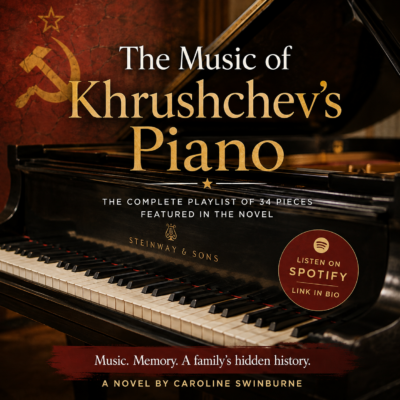
Music lies at the heart of Caroline’s novel Khrushchev’s Piano (The Book Guild, 28 November). The story moves between the Soviet Union at the height of the Cold War and the present day, following three generations of pianists whose lives are shaped, in very different ways, by the instrument.
Each chapter is dedicated to a piece of piano repertoire, ranging from Bach, Scarlatti and Mozart to the great Russian repertoire, jazz and even Justin Bieber. Some pieces are central to the action; others illuminate a character or a particular moment in the story.
Caroline’s put together a complete Spotify playlist of the music from the novel, in the order in which it appears. Below are her chosen performances — and a little about why each piece is there.
LISTEN TO THE COMPLETE KHRUSHCHEV’S PIANO PLAYLIST ON SPOTIFY
The music, in order : –
- Schubert — Impromptu in G-flat Major, D. 899, Op. 90, No. 3 — Alfred Brendel
The Impromptu opens Paul’s musical commentary, its serene surface and stormy middle section echoing the novel’s idea that a life can be overturned in an instant.
- Medtner — Sonata Reminiscenza, Op. 38, No. 1 — Evgeny Kissin
This Russian pianist gives a particularly compelling performance.
Its atmosphere of memory and recollection fits a novel in which Anna gradually reconstructs the hidden musical and emotional history of her family.
- Brahms — Intermezzo in E-flat Minor, Op. 118, No. 6 — Radu Lupu
Brahms’s dark, introspective late music accompanies the early stages of Anna’s grief and her attempts to come to terms with her father’s sudden death.
- Bach — Prelude and Fugue in B-flat Minor, BWV 867 — Sviatoslav Richter
Richter was a member of the jury for the real 1958 inaugural Tchaikovsky Competition which inspired my novel.
The Bach is part of Evie’s competition repertoire, one of the works she plays in the terrifying first round in Moscow.
- Ravel — Gaspard de la nuit — Martha Argerich
Anna’s faltering return to the piano begins with Ondine: at first her old virtuosity seems lost, but concentrated practice gives her the first glimpse of the pianist she once was.
- Debussy — Arabesque No. 2, L. 66 — Walter Gieseking
An older French-school choice.
Paul uses Debussy to reflect on fathers, children and the freedom to choose one’s own path — a theme that runs through Anna’s struggle between law and music.
- Scarlatti — Sonata in D Minor, K. 213 — Racha Arodaky
The Scarlatti sits within Paul’s reflections on keyboard technique and becomes part of the repertoire world into which Anna is slowly returning.
- Taneyev — Prelude and Fugue in G-sharp Minor, Op. 29 — Van Cliburn
This recording comes from Van Cliburn’s triumphant 1958 Tchaikovsky Competition.
This compulsory Russian work is the piece that first draws Evie into the fictional Moscow competition, just as Taneyev featured in the real 1958 competition.
- Mozart — Sonata in A Minor, K. 310 — Mitsuko Uchida
My all-time favourite Mozart pianist.
Evie performs the Mozart in the first round, while Paul’s discussion of its control and expression reflects the novel’s recurring tension between technical perfection and emotional truth.
- Tchaikovsky — Theme and Variations, Op. 19, No. 6 — Van Cliburn
Again, part of Cliburn’s 1958 competition repertoire.
Another compulsory competition work for Evie, it belongs directly to the Russian repertoire through which she is tested — musically and politically — in Moscow.
- Granados — Goyescas, Op. 11: No. 1, Los Requiebros — Alicia de Larrocha
Paul links the flirtatious Los Requiebros to the story of falling in love with Susan, just as Anna begins to rediscover the emotional world she has shut away.
- Balakirev — Islamey, Op. 18 — Olga Kern
Evie practises and performs the notoriously difficult Islamey in Moscow, and Pavel’s praise of her playing helps the two pianists begin to see one another differently.
- Christmas Piano Covers : Frosty the Snowman
**Frosty the Snowman — Piano Seasons / The Christmas Collective (Spotify)*
The T. Roed anthology in the novel is intentionally a bit of a joke, so I’ve chosen a general Christmas piano collection here and picked out Frosty the Snowman, as a piece which Paul mentions as all part of the practical life of a jobbing pianist. It sits heavily against Anna’s experience of family Christmas after her father’s death.
- Scriabin — Étude in D-sharp Minor, Op. 8, No. 12 — Vladimir Horowitz
A classic choice — and a contrast with Cliburn, who also performed the work at the 1958 competition.
Evie’s first-round Scriabin becomes one of the moments when fear gives way to exhilaration and she realises how powerfully she can play under pressure.
- Johann Strauss II — Frühlingsstimmen (Voices of Spring), Op. 410, arr. Ignaz Friedman — Piers Lane
The promise of spring and renewed happiness mirrors a point in the story when Anna’s life is beginning, tentatively, to open out again.
- Prokofiev — Montagues and Capulets, from Romeo and Juliet, Op. 75 — Lazar Berman
The music’s drama and conflict underline the novel’s recurring question of whether love can survive the pressures imposed by family, society and circumstance.
- Gershwin — Rhapsody in Blue — Leonard Bernstein, piano/conductor; Columbia Symphony Orchestra
The 1959 recording dates from the period of the novel, with Bernstein as both pianist and conductor.
Anna hears Thierry perform Rhapsody in Blue at the Conservatoire, and his easy movement between jazz and classical music is part of what fascinates her.
- Chopin — Fantasy in F Minor, Op. 49 — Van Cliburn
This recording appears on An American Wins in Russia.
Chopin belongs to the core Romantic repertoire that links Evie, Paul and Anna across three generations of pianists.
- Beethoven — Sonata in E Minor, Op. 90 — Alfred Brendel
Brendel is a wonderful Beethoven interpreter.
Evie is listening to a Beethoven sonata when she unexpectedly changes her mind about meeting Thierry, helping to bring the past into Anna’s present.
- Liszt — Sonetto 104 del Petrarca, S. 161, No. 5 — Lazar Berman
Beautiful playing, with another link to the Russian pianistic tradition.
Paul writes about the sonnet’s confusion and uncertainty in love at exactly the stage when Anna’s own emotional certainties are beginning to unravel.
- Kosma — Autumn Leaves — solo piano
A jazz standard chosen to suggest the fictional Thierry’s ability to improvise as naturally as he plays classical repertoire.
In the novel this is Thierry Moyet’s own jazz improvisation: this relaxed solo version gives an idea of the sort of performance I imagine him creating at the piano.
- Kabalevsky — Rondo in A Minor, Op. 59 — Nikita Mndoyants
The fiery Rondo is Evie’s solo work in the competition final, and she chooses to play it on Khrushchev’s coveted Steinway.
- Silvestrov — Three Bagatelles, Op. 1 (2005) — Valentin Silvestrov, piano
The composer himself plays these intimate pieces in his own recording.
Silvestrov brings the novel’s Soviet musical history into the present day, as Anna’s story unfolds against the background of Russia’s war in Ukraine.
- Tchaikovsky — Piano Concerto No. 1 in B-flat Minor, Op. 23 — Van Cliburn / Kirill Kondrashin
A recording inseparable from the real 1958 competition that inspired the novel.
This is Evie’s great final-round battle: after a disastrous rehearsal and an attempt to withdraw, she returns to the stage determined to triumph.
- Justin Bieber — Baby — Piano Tribute Players
Paul uses this deliberately unexpected choice to make the point that a working pianist needs versatility, while its adolescent love lyric lightly shadows Anna’s increasingly complicated romantic life.
- Rachmaninov — Piano Concerto No. 3 in D Minor, Op. 30 — Martha Argerich / Riccardo Chailly
The famous live 1982 performance.
This is the work in which Evie takes the greatest musical risk of her Moscow final, choosing the harder cadenza to give the audience “the best possible version” of herself.
- Schumann — Gesänge der Frühe, Op. 133 — Maurizio Pollini
Schumann’s strange, late “Songs of Dawn” accompany a part of the novel concerned with endings, fragile renewal and the possibility of beginning again.
- Copland — Piano Fantasy — Leo Smit
Smit was closely associated with Copland’s music.
Copland broadens the book’s musical world beyond Europe and Russia, while its uncompromising modernism reflects Paul’s appetite for challenging repertoire.
- Liszt — Liebestraum No. 3 in A-flat — Mariam Batsashvili
This is one of the novel’s most intimate musical moments; when words are not enough, music takes over.
- Rachmaninov — Prelude in G Minor, Op. 23, No. 5 — Emil Gilels
I chose Gilels because his wartime performance of the Prelude at the Russian front is discussed in the novel.
The Prelude links the family story directly to Soviet musical history: Evie later insists on an old recording associated with Pavel when the family chooses music for Paul’s funeral.
- Shostakovich — Piano Concerto No. 2 in F Major, Op. 102 — Maxim Shostakovich / I Musici de Montréal / Dmitri Shostakovich Jr.
A particularly apt family recording: Shostakovich wrote the concerto for his son Maxim, who performs it here.
Pavel is the soloist in this concerto at the London Promenade Concert that Evie never manages to attend, making the music part of the great missed opportunity at the heart of their story.
- Schubert — Fantasy in F Minor for piano four hands, D. 940 — Radu Lupu & Murray Perahia
Two distinctive pianists collaborate in this wonderful performance. The four-hand Fantasy embodies musical partnership and shared intimacy, fitting a story in which playing together repeatedly allows characters to communicate beyond words.
- Chopin — Ballade No. 4 in F Minor, Op. 52 — Krystian Zimerman
The Ballade becomes part of Anna’s serious return to the piano.
- V. Solovyov-Sedoi — Moscow Nights — Van Cliburn, piano (arr. Cliburn), live
Cliburn played his own arrangement after his 1958 Tchaikovsky Competition triumph, a gesture that delighted his Soviet audience.
Moscow Nights is the novel’s emotional thread: Evie and Pavel first improvise it together in Moscow, and by the end it has come to represent love, memory and the courage to follow one’s heart.