
First published on The Cross-Eyed Pianist, edited by Frances Wilson.
 My novel Khrushchev’s Piano (The Book Guild, Nov 28th) is a re-imagining of the 1958 inaugural Tchaikovsky competition. The real life story of how brilliant young American pianist Van Cliburn achieved victory against the odds is well-known; in my fictional 1960 Rubinstein Brothers’ Competition it is glamorous British pianist Evie Mason who rises to international acclaim. But life does not run smoothly for my talented protagonist; decades later we re-encounter Evie, now a disabled and impoverished old lady living in a failing care home and still struggling to make sense of events dating from her time in Soviet Russia.
Every chapter of the book is introduced by a different piece of piano music. Often the music is played by my characters; on a few occasions it simply reflects the mood. Much of this repertoire is Russian or Soviet, including several pieces performed at the “real” 1958 competition.
When I began writing the book back in 2017, Ukraine was little-known on the world stage. Even though the country had already endured the annexation of Crimea and years of fighting in the Donbas, it rarely made the headlines in Western news reports. But Russia’s full-scale invasion in 2022 changed that overnight and I could not ignore the implications of recent political events if I wanted my novel to have historical credence. As a result, I re-wrote some of my contemporary storyline to reflect developments and also changed some of the choices of music. It was through this means that I first came across the extraordinary piano music of Valentyn Sylvestrov – or, to use his preferred, Ukrainian transliteration, Valentin Silvestrov.
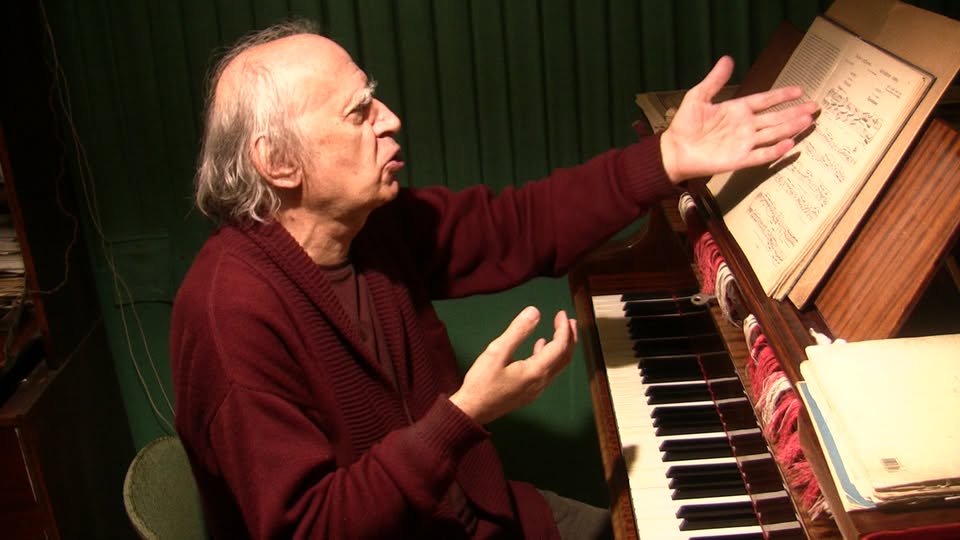
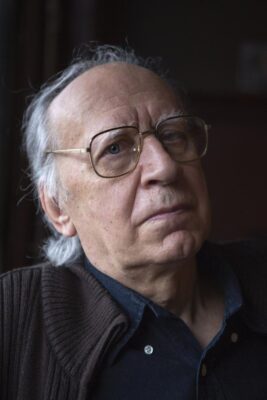
Silvestrov is one of Ukraine’s most distinguished living composers. Although sadly still little-known in the UK, he is more popular elsewhere in Europe, especially in German-speaking countries. Silvestrov’s published work includes symphonies, pieces for chamber orchestra, chamber music and vocal music. But it is his solo piano compositions where – arguably – his most intimate voice is found, especially in his many lovely piano miniatures.
Silvestrov was born in Kyiv in 1937. This makes him the same age as my fictional protagonist, and his life spans exactly the period as my novel – including the final decades of Stalinism, the Khrushchev “Thaw”, Ukraine’s independence in 1991 and, most recently, the Russian invasion of his homeland. But despite this dramatic political backcloth, the composer’s musical style has remained unique, independent and personal.
By the time of my fictional competition in 1960, Silvestrov was a student at the Kyiv Conservatory, where he studied composition with Borys Liatoshynsky and Levko Revutsky. Liatoshynsky, more than forty years his senior, had once been a pioneering Ukrainian modernist, but belonged to a generation whose artistic freedom had been severely curtailed by Soviet ideology. However, as a teacher, he encouraged younger composers including Silvestrov to pursue their own ideas.
Fortunately, this was a time when the Khrushchev “Thaw” was opening up new possibilities, and after graduating, for a while Silvestrov became closely associated with the Kyiv Avant-Garde, a loose circle of composers including Leonid Hrabovsky, Vitalii Hodziatskyi and Volodymyr Zahortsev. The group were keenly interested in Western modernism – from Webern and the Second Viennese School to the experiments emerging from Darmstadt – but also concerned to develop their own distinctive musical language within the wider artistic and intellectual life in 1960s Kyiv.
Silvestrov’s music soon began to attract international attention. German philosopher, musicologist and social theorist Theodor Adorno described him as an ‘extraordinarily gifted’ composer. In September 1968, Bruno Maderna conducted the world premiere of his third symphony, Eschatophony, at the Darmstadt Summer Courses – a principal centre of the European avant-garde. In 1967 the work was awarded the Koussevitzky Music Foundation Prize and three years later his Hymn received an honorary distinction at the Gaudeamus International Composers Competition in Utrecht.
Silvestrov was not a natural rebel; he described his relationship with Soviet institutions as a kind of gentle non‑compliance and emphasised that he simply wrote the music he felt compelled to write. From the 1970s onwards he moved away from radical modernism towards what he described as a ‘metaphorical’ style – a way of writing which absorbed echoes of the past without simply reverting to traditional tonality. This was not a response to political repression, but rather, part of a deeper artistic journey – a conscious artistic decision made by a composer who had already achieved international recognition.
Kitsch-Musik, written in 1977, is one of the most important and frequently performed of his early piano works and marks his transition towards this new style. The piano cycle is published by Schott Music, whose catalogue includes many of Silvestrov’s best-known scores, although much of the composer’s later work, including many piano miniatures, have sadly never appeared in print. However, many of the unpublished works have been recorded often by the composer himself – and are readily available in a large online archive, at https://silvestrov.bandcamp.com/
After Russia’s full-scale of Ukraine in 2022, Silvestrov fled Kyiv with his daughter and granddaughter and has since lived in Berlin. Although he is aged nearly ninety and has hearing problems, he has continued to compose prolifically and for a while, continued to post regular recordings of his music in the Bandcamp archive. However, in recent years, his own performances have become less frequent, and many recent premieres and recordings have been entrusted to the Ukrainian pianist Evgeny Gromov, one of the foremost interpreters and champions of the composer’s piano music.
In my book, I feature Silvestrov’s lovely Three Bagatelles op 1. These works, written in 2005, are intimate, lyrical, and accessible. Comparing the compositions to his larger works, the composer wrote: ‘My second Sonata, for example, is a concert piece, and is not designed to be played in a domestic setting. But [the piano miniatures] are pieces which one can play (or listen to) at home, even if they require a subtle use of the pedal and sophisticated timbres. These are, as it were, domestic animals such as cats, whereas the works based on a philosophical idea can be compared to tigers, which are also cats, though it is impossible to keep them as domestic animals.’ (Valentin Silvestrov Music, the song the world sings about itself, Kyiv 2004: in Russian)
Tame, domestic cats they may be, and at first sight the notes themselves seem relatively straightforward, but like all Silvestrov’s music, the Bagatelles pose significant challenges if the pianist is to do full justice to the composer’s vision. Minutely-notated nuances of duration, dynamics, tempo and pedalling are an integral part of the works and take time, attention and thorough practice to master effectively.
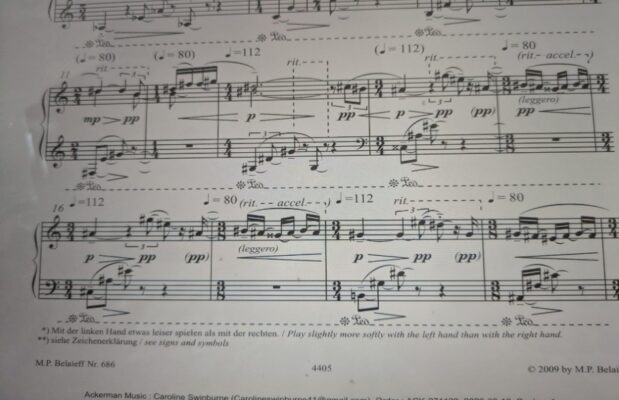 ‘The expressive meaning [of Silvestrov’s music] resides less in the notes themselves than in their breathing, timing, decay and infinitesimal dynamic inflections,’ says Yar Godyna, who curates the composer’s online archive and knows the composer well. ‘This music demands an exceptional sensitivity to tone, timing, pedalling and the natural decay of sound. It also requires patience: one has to resist the temptation to “express” too much or to impose an overt personal interpretation. The music speaks quietly, and the performer has to trust that quietness.’
However, Godyna thinks that much of Silvestrov’s later piano music is technically accessible to a good amateur pianist as long as he or she is prepared to be thorough. He suggests beginning with Kitsch Music or the earlier published Bagatelles, which are accessible, and provide an excellent introduction to the composer’s musical language. ‘Above all, I would advise [the would-be performer] to listen carefully to Sylvestrov’s own performances on the bootcamp archive. He rarely treats the score mechanically; despite the extraordinary detail of his notation, his playing sounds remarkably free, almost improvised. That apparent paradox is perhaps the most important lesson for anyone approaching his music.’
Drawing parallels with the writing of Eric Satie, Godyna considers that Silvestrov’s piano works: ‘reward maturity more than virtuosity. A pianist with a beautiful touch, a sense of silence and the ability to sustain long musical lines will often be more convincing than a brilliant virtuoso who approaches the music as a display of technique.’ [Silvestrov’s piano miniatures] demand an exceptional sensitivity to tone, timing, pedalling and the natural decay of sound. [They] also require patience: one has to resist the temptation to “express” too much or to impose an overt personal interpretation. The music speaks quietly, and the performer has to trust that quietness.’
Useful resources
On-line archive : https://silvestrov.bandcamp.com/
Silvestrov’s writings and conversations have been published in several collections, including Music Is the Song the World Sings About Itself…, ed. Marina Nestieva (Kyiv, 2004, Russian), and the later Waiting for Music (Дочекатися музики) and Meetings with Valentin Silvestrov (Зустрічі з Валентином Сильвестровим), published in Ukrainian by Dukh i Litera.
Silvestrov talking and playing his work https://www.youtube.com/watch?v=GJ_7-a1-svg
Pianist Evgeny Gromov playing music of twentieth-century Ukrainian pianists, including Silvestrov. https://www.youtube.com/watch?v=AfibvNrARtE&list=RDAfibvNrARtE&start_radio=1
Khrushchev’s Piano will be published by The Book Guild on November 28th