
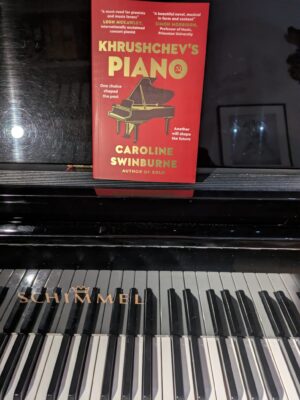
My novel Khrushchev’s Piano is a reimagining of the inaugural International Tchaikovsky Competition, held in 1958 in Soviet Moscow at the height of the Cold War. In my story, Van Cliburn is reinvented as glamorous young British pianist Evie Mason, and the first prize in the fictional “Rubinstein Brothers Competition” is a valuable Steinway piano awarded by the Soviet Premier.
Decades later, we re-encounter Evie as an impoverished and disabled old lady living in a failing care home still struggling to come to terms with her past. She’s grief-stricken by the unexpected death of her beloved son Paul and determined that her pianist-turned-lawyer granddaughter Anna will make wiser life choices.
Music is not just a backdrop to my novel – it’s the reason the story exists. Most of the main characters – Evie, Anna, Paul, jazz pianist Thierry, and Evie’s Soviet rival Pavel – are pianists. Their every major decision, every triumph, every disappointment and every relationship ultimately revolves around music. It determines where they live, whom they meet, whether they travel, and whether they succeed or fail. For this reason, each chapter is themed around a piece of piano repertoire, brought to life with a short ‘programme note’, presented as an extract from a book by Paul, left unfinished at his premature death.
Music to drive the plot
Evie calms her nerves during her plane trip to Moscow by memorising a complicated five-voice Bach fugue. Later, performing the notoriously difficult Rachmaninov Third Piano Concerto, she decides at the last moment to risk all and play the harder of the two cadenzas. And it is more Rachmaninov – this time the stormy, ominous Prelude in G minor, Op. 23 No. 5 – which she is playing at the moment when life-changing disaster befalls her.
French jazz pianist Thierry wows an audience with his rendition of Gershwin’s Rhapsody in Blue. Anna, distracted by romantic entanglements, is distraught when she messes up her dream piece, Chopin’s Fourth Ballade. And the disastrous consequences of Pavel’s below-par performance of Shostakovich’s Second Piano Concerto at the Proms extend far beyond the concert hall.
Music as witness to history
Tchaikovsky’s Theme and Variations, Taneyev’s Prelude and Fugue, Kabalevsky’s Rondo, and the Tchaikovsky and Rachmaninov concertos all featured in the real-life 1958 competition. The Soviet song Moscow Nights, which Evie first encounters on a vodka-fuelled night out in Moscow, evokes the Khrushchev Thaw. Copland’s Piano Fantasy opens a discussion of Cold War politics. And the music of contemporary Ukrainian composer Valentin Silvestrov contributes a musical strand to the historical tragedy of the Russian invasion of his homeland.
Music to understand a pianist’s character
A pianist’s musical tastes are hugely revealing of their true character and although Paul dies early in the story, he is given a voice through his musical tastes. He loves the great Romantics – Chopin, Rachmaninov and Liszt – but also feels affinity with the Baroque composer Scarlatti. Like Scarlatti, Paul was modest and unambitious, but also capable of the most profound expression. Music mattered deeply to Paul, but prestige did not.
Music and memory
Even as a hardened and embittered old lady, Evie is moved to tears by Liszt’s third Liebestraum. Granados’s Goyescas reminds Paul of his immediate attraction when he first set eyes on Susan, his wife-to-be. And even though Anna is convinced that her piano-playing days are behind her, she is deeply unsettled when she chances upon a station pianist at St Pancras massacring one of her favourite pieces, Schubert’s Impromptu in G-flat major, D899 No. 3.
Music and the working pianist
My repertoire list contains some of the greatest piano music ever written, but most jobbing pianists will also spend time playing whatever is asked of them, ranging from music for children, Christmas carols, jazz and popular music. Paul is as much at home playing Justin Bieber covers in a piano bar, or carols at a school concert, as performing Rachmaninov or Liszt in the concert hall.
Music to set an emotional tone
Most of the repertoire in my book is played by my characters, but a few pieces have been chosen simply to echo the emotional landscape. This is not without its hazards; it is acceptable to describe music as “gentle”, “peaceful” or “smooth” – or, at the other extreme, “tense”, “turbulent” or “unresolved”. But unless a composer has actually stipulated a ‘programme’ (an extra-musical interpretation) of a work, it is not only foolhardy but missing the point for a writer to attempt any exact ‘translation’; music, by its very nature, is beyond words.
But sometimes the composer leaves clues. Mozart’s Piano Sonata in A minor, K310, which a grief-stricken Anna listens to in Chapter Ten, was composed around the time of his mother’s death and is one of only two sonatas he wrote in a minor key; its agitation, darkness and emotional intensity make it a powerful counterpart to Anna’s state of mind.
The Brahms Intermezzo in E-flat minor, Op. 118 No. 6, which is heard at Paul’s funeral, opens with a motif that has been interpreted as an allusion to the medieval Dies irae – the plainchant melody which has been used to evoke death by composers ranging from Berlioz to Rachmaninov.
And the two-movement Beethoven Sonata, Op. 90, sets the theme in a chapter in which Evie changes her mind on an important plot point. The first movement, in the minor, is full of dramatic exclamations and gestures, while the second, in the tonic major, is gentle and lyrical. Beethoven’s admittedly often unreliable biographer Anton Schindler claimed that the composer characterised the two movements in terms of a ‘contest between head and heart’ and a ‘conversation with the beloved’.
Hearing the novel
People have asked me whether the chapter introductions are essential to the story, and my answer is that they are part of the story. If a reader skips them, they won’t lose the plot – but they will miss an opportunity to hear the novel as its characters hear it.
For Evie, Paul, Anna, Thierry and Pavel, music isn’t an accomplishment or a hobby. It’s the language through which they understand love, ambition, grief, politics and memory. I wanted the reader to inhabit that world too.
Explore the complete playlist of music featured in Khrushchev’s Piano