

Caroline first visited Russia and (as was then) “The Ukraine” back in the 1980s on a trip organised by Intourist, the state tour operator back in Soviet days. She returned to Moscow in 2019 to research her novel Khrushchev’s Piano. These are a few of her memories:
My first encounter with the Soviet Union
I knew I’d kept a not-quite-teenage diary of my first trip to the Soviet Union, back in the 1980s. I remembered filling it with breathless accounts of drunken encounters with friendly locals who’d somehow managed to evade the watchful eyes of our Intourist guides, tales of endless visits to hydroelectric power stations, collective farms and war memorials, and detailed descriptions of the food: borscht, unidentifiable meat cutlets, boiled potatoes and lukewarm glasses of kompot (stewed fruit). All washed down with liberal quantities of Sovetskoye Shampanskoye (Soviet sparkling wine) and rather too much vodka.

But I hadn’t seen the diary for decades and assumed it had disappeared during one of my countless house moves.
Then, when I was researching Khrushchev’s Piano, there it was! My little red book, covered in dust and buried at the bottom of an old cupboard. It seems I’d commandeered an old exercise book belonging to one of my mother’s Latin pupils — whose name is still visible on the cover, firmly crossed out and replaced with my own!
Re-reading the diary all those years later was hilarious, embarrassing and unexpectedly useful. Here was a treasure trove of details I’d long forgotten — the sights, sounds, tastes and peculiarities of everyday Soviet life.
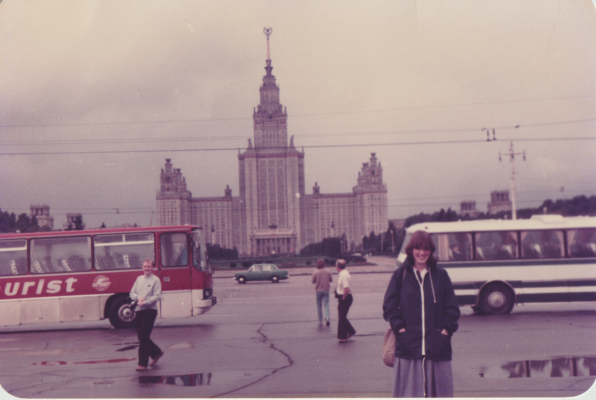
And although my fictional pianist Evie Mason travelled to Moscow in 1960, more than twenty years before my own trip, we’d been about the same age. My youthful scribblings turned out to be pure gold dust, packed with the sort of vivid, unexpected details I could never have invented — and providing wonderful material for Evie’s own diary.
The Soviet Piano
 I love this picture from a Moscow museum, showing the piano taking centre stage in Soviet family life.
Soviet factories produced thousands of pianos, including the famous Red October instruments made in Leningrad. No self-respecting, culturally ambitious family wanted to be without one. And a nationwide network of specialist music schools aimed to identify and nurture musical talent, including children from less privileged backgrounds. Access wasn’t always as equal as the authorities liked to claim, but the system helped produce some of the greatest pianists of the twentieth century.
There was, of course, a very great deal wrong with the Soviet system. But when it came to music education, perhaps they could teach us a thing or two. In Britain today, instrumental lessons in state schools are expensive and increasingly difficult to access, while university music departments face cuts and closures. What does that say about how much we value music — and who gets the opportunity to make it?
Music education, the piano and the extraordinary achievements of Soviet pianists all form part of the background to my forthcoming novel, Khrushchev’s Piano, published on 28 November.
A return to Moscow


When I returned to Moscow in 2019 to research Khrushchev’s Piano, it was a rather different experience from my first visit back in the Soviet 1980s.
This time, no Intourist minders, no carefully controlled itineraries, and no restrictions on chatting to the locals!
One of the highlights was visiting the magnificent Great Hall of the Moscow Conservatory, where the original International Tchaikovsky Competition took place, and hearing a wonderful piano recital. But here’s the strange thing. The pianist turned out to be almost exactly how I’d imagined Pavel Mikhailov, one of the fictional characters in my novel. It was as though he’d stepped straight out of the manuscript.
Victor Bunin : The pianist who remembered 1958


One of the highlights of my research for Khrushchev’s Piano on the 2019 trip was meeting the Russian pianist Victor Bunin, who had attended the inaugural International Tchaikovsky Competition in Moscow in 1958 as a young music student. He remembered the excitement of hearing extraordinary young pianists from around the world, at a time when performances by foreign musicians were a rare luxury in the Soviet Union.
He even drew me this little sketch of the backstage layout, helping me picture the contestants waiting nervously to go on stage.
It’s those small, first-hand details that no amount of reading can quite replace.
Five-star Soviet luxury


 PH

When I visited Moscow in 2019 to research Khrushchev’s Piano, there was only one place I wanted to stay: the Hotel Pekin, where competitors in the inaugural International Tchaikovsky Competition had been accommodated back in 1958.
The hotel opened in 1956, its name proudly celebrating the great friendship between the Soviet Union and Communist China. Unfortunately, by 1960 the two countries were barely on speaking terms. So much for socialist brotherhood.
In its heyday, the Hotel Pekin was the last word in Soviet luxury, with a distinctly Chinese flavour. All red and gold, with Chinese lanterns and vases everywhere, it must have seemed wonderfully exotic. It was also a notorious KGB haunt, where receptionists reportedly kept tabs on guests’ comings and goings, and listening devices were well-known to lurk in the bedrooms.
Despite all the superficial grandeur, visiting pianists in 1958 complained about the minimal service, mediocre food and filthy rooms.

Not a huge amount had changed by the time I visited in 2019. Despite the enticing promises in the brochure, my own room was on the basic side when it came to creature comforts. Particularly the bathroom, where the water emerged from the taps a rather alarming shade of brown.
Still, I was there for the atmosphere, not the plumbing. And with the ghosts of Van Cliburn and his fellow competitors lurking around every corner, it was the perfect place to imagine my fictional pianist, Evie Mason, arriving sixty years earlier.
Researching Khrushchev’s Piano meant trying to recreate not just the great political events of the Cold War, but the texture of everyday Soviet life. Even the food.
Food
 The USSR didn’t have the best of culinary traditions. On my first visit in the 1980s, we survived on borscht, breaded meat cutlets, boiled potatoes and glasses of lukewarm kompot (fruit drink). It was only made bearable by copious supplies of sweet fizzy wine known, optimistically, as “Sovietski Shampagnski” and rather a lot of vodka.
When I returned to Moscow in 2019, my lovely guide Christina took me to visit a retro Soviet café where I could relive some of those unforgettable culinary experiences.
Actually this time it wasn’t bad at all. Almost quite tasty. Perhaps thirty years of capitalism had done wonders for Soviet cuisine. Or perhaps my memories of the 1980s were a little too vodka-soaked to be entirely reliable.